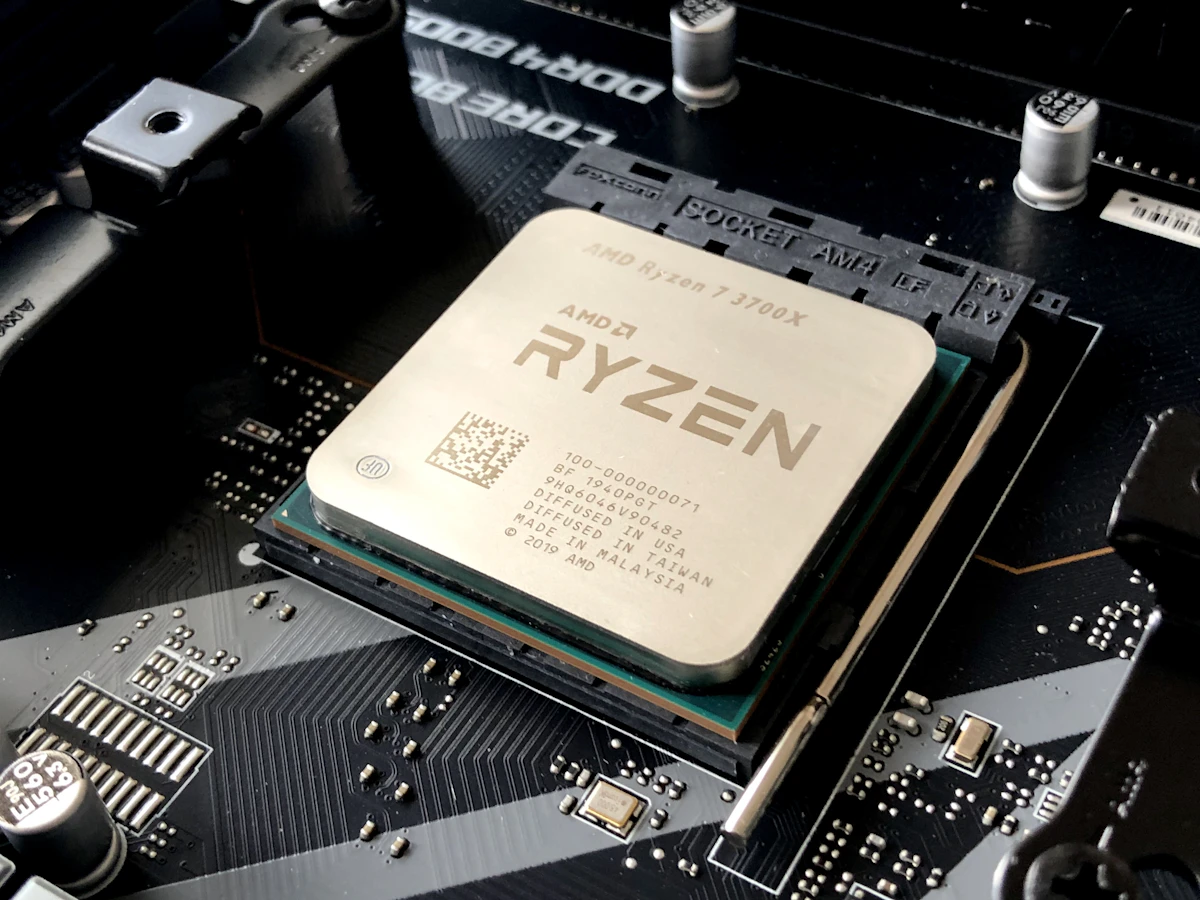
Advanced Micro Devices (AMD) has crossed the historic $1 trillion market valuation barrier, becoming only the fourth United States semiconductor manufacturer to achieve this milestone alongside NVIDIA, Broadcom, and Micron. The stock rally reflects a structural transformation in the artificial intelligence compute ecosystem, where cloud providers are actively deploying dual-vendor hardware architectures.
Driven by an equity rally exceeding 180% year-to-date, AMD reached a valuation of $1.03 trillion. The surge follows AMD's record quarterly report showing $6.7 billion in Data Center segment revenue—a 107% increase compared to the previous year.
Datacenter Revenue Surge: MI350X and the MI450 Architecture
For years, Wall Street viewed AMD as a secondary competitor relegated to client CPUs and gaming GPUs. Under CEO Lisa Su, AMD systematically re-engineered its engineering roadmap toward enterprise compute. The Instinct MI350X and newly announced MI450 series have broken NVIDIA's absolute pricing dominance in large language model training and inference.
Fabricated on TSMC's 3-nanometer class nodes and utilizing 3D chiplet packaging with up to 288GB of ultra-fast HBM3e and HBM4 memory, the MI450 delivers over 1.8x the raw FP8 memory bandwidth of comparable monolithic accelerators. This specific parameter allows hyperscalers to fit 70-billion-parameter foundation models entirely in single-node GPU memory without partitioning across slower PCIe switches.
| Compute Platform Specification | NVIDIA GB200 NVL72 | AMD Helios MI450 Rack Solution |
|---|---|---|
| Silicon Architecture | Blackwell Dual-Die Monolithic | CDNA 4 Multi-Die 3D Chiplet Stack |
| Memory Capacity per Accelerator | 192 GB HBM3e | 288 GB HBM3e / HBM4 (48-hi Stacks) |
| Interconnect Fabric | NVLink 5 (1.8 TB/s bidirectional) | Infinity Fabric 4.0 + Ultra Ethernet (UEC) |
| Software Ecosystem | CUDA 13 (Proprietary Lock-in) | ROCm 6.3 (Open Source, Native PyTorch Support) |
| Thermal & Power Envelope | 120 kW per Full Rack (Liquid Only) | 105 kW per Helios Rack (Hybrid Liquid/Air Option) |
OpenAI and Meta Multi-Year Cluster Commitments
A core catalyst propelling AMD into the trillion-dollar club is the signing of multi-billion-dollar cluster purchase agreements with OpenAI and Meta Platforms. Both technology giants had grown wary of single-source supply chain bottlenecks and margin compression caused by premium GPU acquisition costs.
Meta has integrated AMD's MI350 accelerators into its recommendation engine pipelines, which drive ad delivery across Instagram and Facebook. Meanwhile, OpenAI is deploying AMD Helios rack-scale systems to serve inference queries for its lightweight reasoning models, preserving high-cost Blackwell systems for large-scale pre-training cycles.
The Maturation of ROCm 6.3 and Open Standards
Historically, AMD's primary hurdle was not raw floating-point computing power, but software compatibility. NVIDIA's CUDA created a software wall that kept machine learning researchers bound to GeForce and Hopper hardware. With the release of ROCm 6.3, that barrier has fallen:
- Zero-Code Triton Compiler Integration: OpenAI's Triton language compiles directly to AMD CDNA machine code without intermediate CUDA conversion layers.
- Day-One PyTorch Day-Zero Parity: Every major PyTorch 2.5 feature, including FlashAttention-3 and vLLM kernel optimizations, runs natively on Instinct silicon.
- Ultra Ethernet Consortium Backing: By joining Microsoft, Arista, and Cisco to champion open Ethernet networking over proprietary InfiniBand switches, AMD avoids high network licensing costs.
EPYC Turin and the Agentic AI Compute Wave
Beyond graphics processors, AMD's fifth-generation EPYC "Turin" processors built on the Zen 5 architecture have captured over 38% of the global server CPU market. Autonomous agentic AI workloads require extensive host preprocessing—orchestrating tool calls, database lookups, and code sandboxing—prior to passing tokens to the GPU.
With up to 192 cores per dual-socket server, EPYC Turin handles this high-density agentic preprocessing with significantly lower watt-per-core ratings than legacy x86 architectures. As datacenter power budgets hit grid constraints, AMD's integrated portfolio of CPUs, GPUs, and networking silicon provides a resilient runway to sustain its trillion-dollar status.



💬 Reader Discussion & Feedback 0