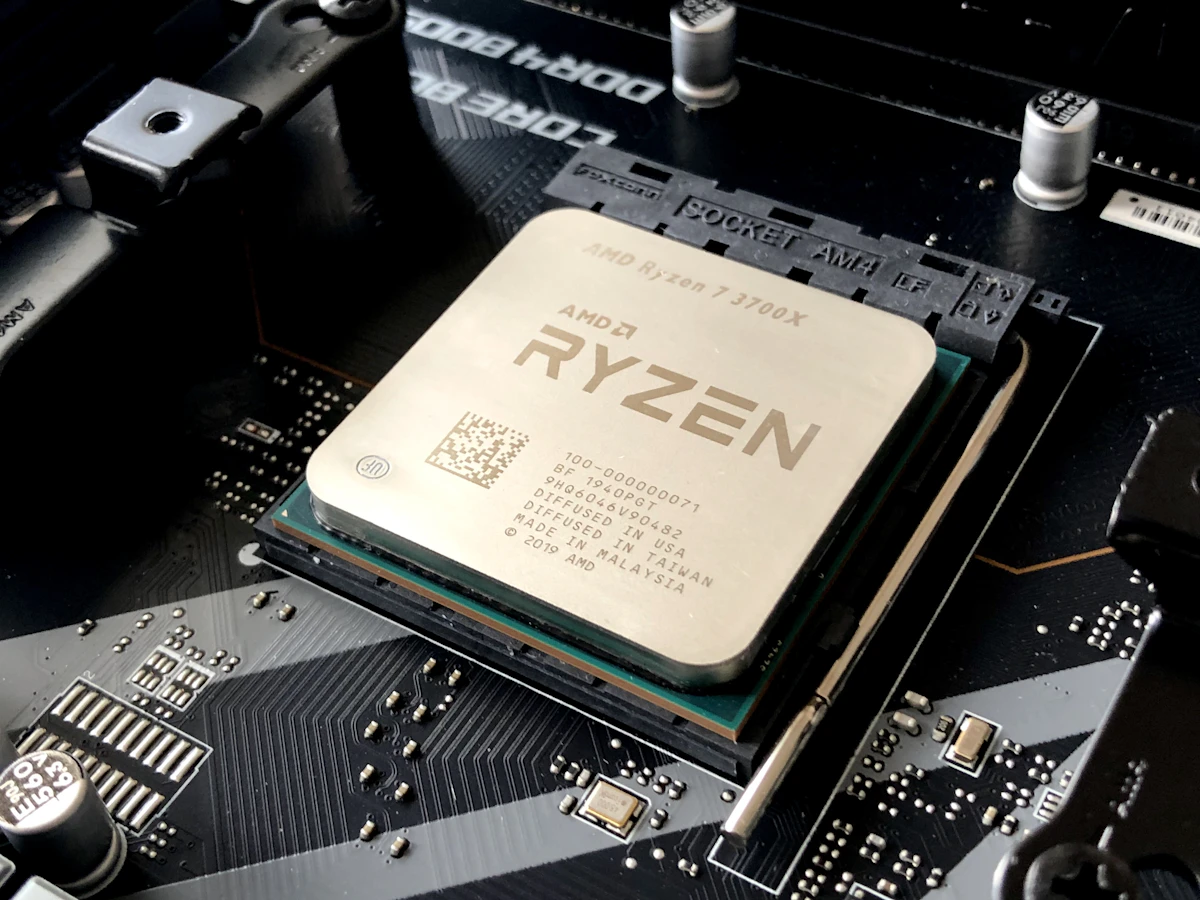
When AMD unveiled the Ryzen 7 5800X3D and subsequent Ryzen 7 7800X3D, the chips quickly established themselves as undisputed monarchs of gaming performance. By vertically bonding an extra 64MB of high-density SRAM cache directly to the silicon die, AMD dramatically reduced high-latency roundtrips to system RAM. Yet, both processors suffered from a critical limitation: rigid thermal constraints that forced AMD to lock core voltage and disable manual multiplier overclocking.
With the impending arrival of the Ryzen 7 9800X3D built on the Zen 5 "Granite Ridge" architecture, leaked packaging and engineering documentation reveal that AMD has completely inverted its 3D die-stacking configuration to conquer thermal bottlenecks and unlock full overclocking headroom.
The Thermal Flaw of 1st and 2nd Gen 3D V-Cache
In previous X3D designs, the 64MB 3D V-Cache die was bonded directly on top of the Core Complex Die (CCD). To ensure even mechanical height across the package, structural silicon shims were placed over the remaining area of the CPU cores.
This layout created a severe thermodynamic penalty. Silicon is an effective heat insulator. Because the sensitive SRAM cache was sandwiched between the blazing-hot compute cores and the copper Integrated Heat Spreader (IHS), heat produced by the Zen 4 execution engines had to migrate upward through the cache layer before reaching the CPU cooler. To prevent thermal degradation of the cache retention cells, AMD enforced strict voltage caps (roughly 1.15V–1.20V) and dialed down maximum single-core boost clocks by several hundred megahertz compared to non-X3D variants.
Inverted Stacking: Cache Below, Cores on Top
For the Zen 5 generation, AMD semiconductor packaging engineers re-engineered the through-silicon via (TSV) interconnects to flip the physical stacking order:
- SRAM Cache on the Substrate: The 64MB 3D V-Cache die is now positioned directly on the organic package substrate at the bottom of the stack.
- Compute Die on Top: The active Zen 5 Core Complex Die (housing 8 high-performance cores and 16 threads) sits directly on top of the cache.
- Direct Thermal Contact: The compute cores now make direct surface contact with the CPU's gold-plated copper heat spreader.
This inverted geometry fundamentally alters thermal dissipation dynamics. High-wattage heat generated during intense gaming bursts transfers straight into liquid cooling blocks or air coolers without cooking the cache below. As a direct result, AMD has eliminated the artificial frequency deficit. The Ryzen 7 9800X3D is reported to feature an out-of-the-box base clock of 4.7 GHz and boost ceilings pushing past 5.2 GHz.
Full Multiplier Overclocking Confirmed
Because thermal transfer efficiency is no longer compromised, motherboard manufacturers confirm that the 9800X3D will be the first fully unlocked 3D V-Cache processor in history. Enthusiasts will enjoy unrestricted access to:
- Manual Core Multipliers: Push all-core frequencies beyond 5.4 GHz on premium X870 and X670E motherboards with sufficient cooling.
- Precision Boost Overdrive (PBO) & Curve Optimizer: Fine-tune per-core voltage-frequency curves to extract maximum efficiency.
- Extreme Memory Profiles (EXPO): Tighter sub-timing tuning and high-speed DDR5-6000+ support without memory controller stability degradation.
Expected Gaming Impact
While standard productivity benchmarks will benefit from Zen 5's wider 6-wide dispatch engine and native 512-bit AVX-512 data paths, gaming remains the primary target. Titles notorious for heavy CPU simulation bottlenecks—such as Microsoft Flight Simulator 2024, Baldur's Gate 3, and Escape from Tarkov—will see massive improvements in 1% and 0.1% low frametimes, eliminating micro-stutters during heavy multiplayer encounters. The Ryzen 7 9800X3D is set to reinforce AMD's dominant position at the apex of gaming hardware.
In-Depth Hardware Benchmarks, System Stability, and Diagnostic Steps
System performance optimization and component reliability require a methodical approach to diagnostic telemetry and firmware calibration. Operating systems frequently enable background hypervisor isolation and aggressive scheduling policies that, while improving platform security, introduce measurable frame-time variance and thermal throttles during sustained heavy throughput tasks.
System Engineering and Hardware Checklist
- Driver Validation: Ensure clean display and chipset driver installations via dedicated uninstaller utilities to prevent residual registry conflicts.
- Storage Bus Saturation: Verify that PCIe NVMe solid-state storage operates at full x4 link width within system BIOS firmware to maximize sequential throughput.
- Memory Profiling: Enable standardized XMP or EXPO memory profiles while monitoring system stability through comprehensive memory stress diagnostics.
- Background Task Management: Restrict non-essential telemetry services and scheduled background tasks to preserve CPU core availability for foreground applications.
Long-Term Maintenance and Reliability Guidelines
Conducting routine preventative maintenance—including thermal paste reapplications, heatsink cleaning, and storage SMART health audits—prevents sudden hardware degradation and guarantees stable, high-performance operation over multi-year deployment cycles.


💬 Reader Discussion & Feedback 0