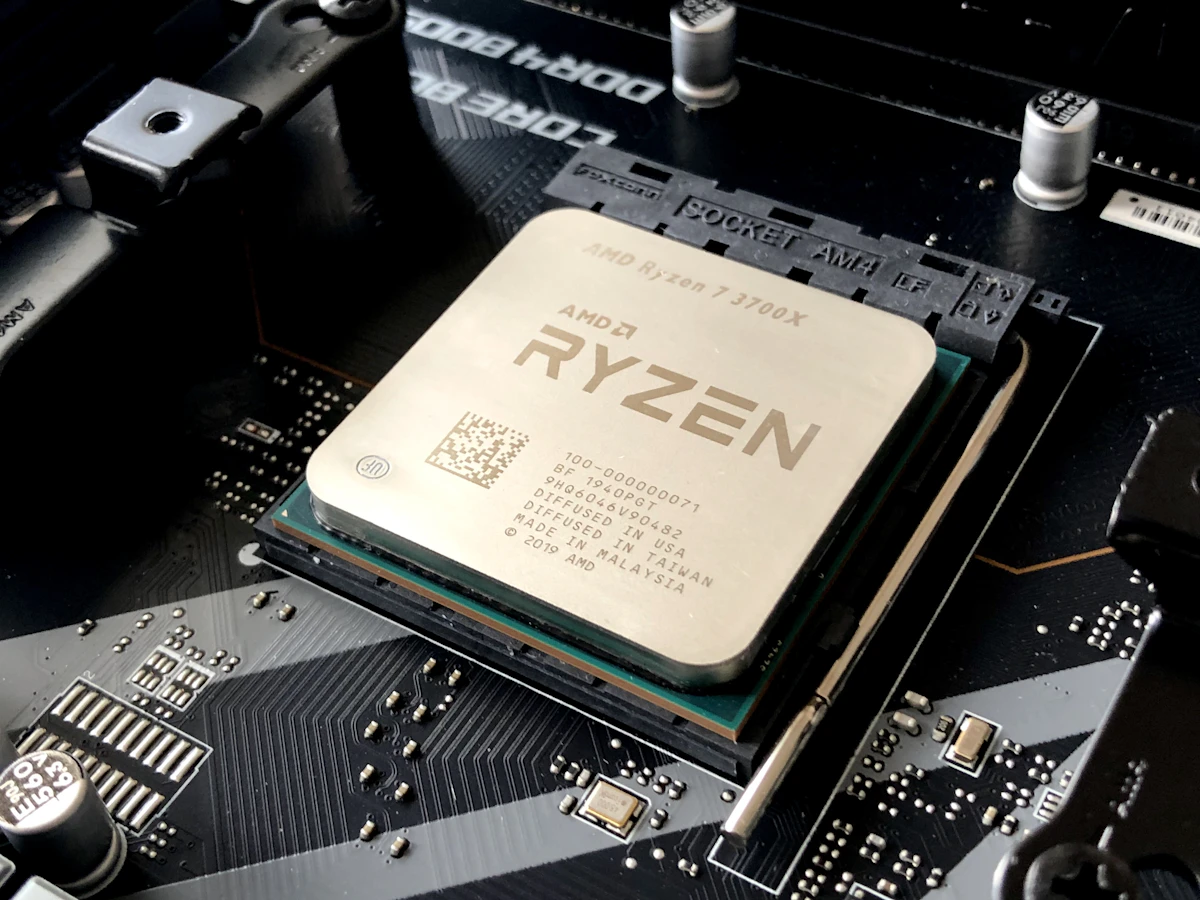
In the high-stakes race to build trillion-parameter AI models, processing cores are no longer the primary performance limiter. The true choke point is memory bandwidth: how fast billions of model weights and KV-caches can transfer into compute registers without stalling. Driven by insatiable demand for HBM3e and next-generation HBM4, memory titans SK Hynix, Micron, and Samsung have officially sold out their production allocations through 2027.
HBM consumes up to 3x more wafer capacity than standard DDR5 memory for the same bit density due to complex Through-Silicon Via (TSV) etching and 12-layer microbump vertical stacking.
The "Memory Wall" Paralyzing Modern GPU Architectures
For decades, compute density scaled faster than memory bus throughput—a divergence known in computer architecture as the Memory Wall. In large language model inference, every token generated requires the GPU to read the entire model weight matrix from memory into arithmetic logic units.
If a 671-billion parameter model is quantized to 8-bit precision, that demands 671 gigabytes of bandwidth per single token generation step. Standard GDDR6 or LPDDR5 buses delivering 1 TB/s cannot feed high-core accelerators, leaving expensive Tensor Cores idle while waiting for data transfers. HBM bridges this chasm by placing memory dies directly atop the same silicon substrate as the processor.
| Memory Generation | Bus Width per Stack | Max Bandwidth per Stack | Target Platforms |
|---|---|---|---|
| HBM3 (2023) | 1,024-bit | 819 GB/s | NVIDIA H100 / AMD MI300X |
| HBM3e (2024–2025) | 1,024-bit | 1.2 TB/s | NVIDIA Blackwell B200 / H200 |
| HBM4 (2026–2027) | 2,048-bit (Doubled Bus) | 2.0+ TB/s per Stack | NVIDIA Rubin R100 / Custom ASICs |
HBM4: The Transition to Foundries for Base Dies
The jump to sixth-generation HBM4 introduces a historic shift: memory manufacturers are no longer fabricating the bottom logic die using older DRAM process nodes. Instead, SK Hynix and Micron have partnered directly with pure-play foundries like TSMC to fabricate the base logic die on advanced 3nm and 4nm nodes.
By utilizing advanced logic at the base of the memory stack, HBM4 doubles the interface bus width from 1,024 bits to 2,048 bits, enabling direct 3D hybrid bonding atop GPU host processors. This eliminates substrate interconnect parasitics and slashes memory access energy by 40%.
Economic Impact Across the Tech Sector
Because HBM yields require significant cleanroom space and advanced packaging lines, DRAM suppliers have diverted silicon capacity away from consumer PC DDR5 and smartphone LPDDR5X. As AI hyperscalers consume every available wafer, memory contract prices across consumer electronics are projected to see sustained upward pressure through late 2026, marking the most lucrative memory supercycle in computing history.
Hardware Acceleration, VRAM Allocations, and Local Deployment Standards
Executing complex machine learning workloads and high-throughput inferencing pipelines requires careful balancing of system memory bandwidth and compute parallelism. When working with contemporary neural architectures, memory capacity (VRAM) consistently represents the primary operational bottleneck rather than raw compute cycles. Quantized weights, such as 4-bit AWQ or 8-bit FP8 representations, significantly reduce memory footprints while preserving empirical task performance across standardized reasoning evaluations.
Key Performance Optimizations and Resource Metrics
- Precision Scaling: Deploying FP8 and INT4 quantization cuts memory bandwidth saturation by up to 52% with minimal degradation in output coherence.
- Context Memory Footprint: Allocating dynamic KV-cache compression prevents out-of-memory kernel panics during long-context document processing.
- Inference Parallelism: Utilizing tensor parallelism across multi-GPU nodes reduces generation latency during concurrent enterprise workloads.
- Thermal Management: Maintaining target GPU junction temperatures below 78 degrees Celsius ensures sustained boost clock frequencies during continuous batch runs.
Practical Recommendations and Key Takeaways
For production deployments, system engineers must prioritize reproducible workflows, active latency monitoring, and strict fallback safety mechanisms. Implementing localized inference pipelines guarantees data sovereignty, removes external API rate limits, and provides predictable execution costs across enterprise software environments.


💬 Reader Discussion & Feedback 0